Friday, August 02, 2013
Class XI-A2: Smart Class Activity for Geography Students Class ...
Class XI-A2: Smart Class Activity for Geography Students Class ...: During last week (17 - 20 July, 2013) the Geography students of Class XI-B2 and XI-A2 took part in the Smart Class Activity on Chapter ...

Friday, May 10, 2013
Saturn's Cyclone - a view from Cassini Spacecraft

Explanation: Acquiring its first sunlit views of far northern Saturn late last year, the Cassini spacecraft's narrow-angle camera recorded this stunning image of the vortex at the ringed planet's north pole. The false color, near-infrared image results in red hues for low clouds and green for high ones, causing the north-polar hurricane to take on the appearance of a rose. Enormous by terrestrial hurricane standards, this storm's eye is about 2,000 kilometers wide, with clouds at the outer edge traveling at over 500 kilometers per hour. The north pole Saturn hurricane swirls inside the large, six-sided weather pattern known as the hexagon. Of course, in 2006 Cassini also imaged the hurricane at Saturn's south pole.
Spiral Galaxy M77
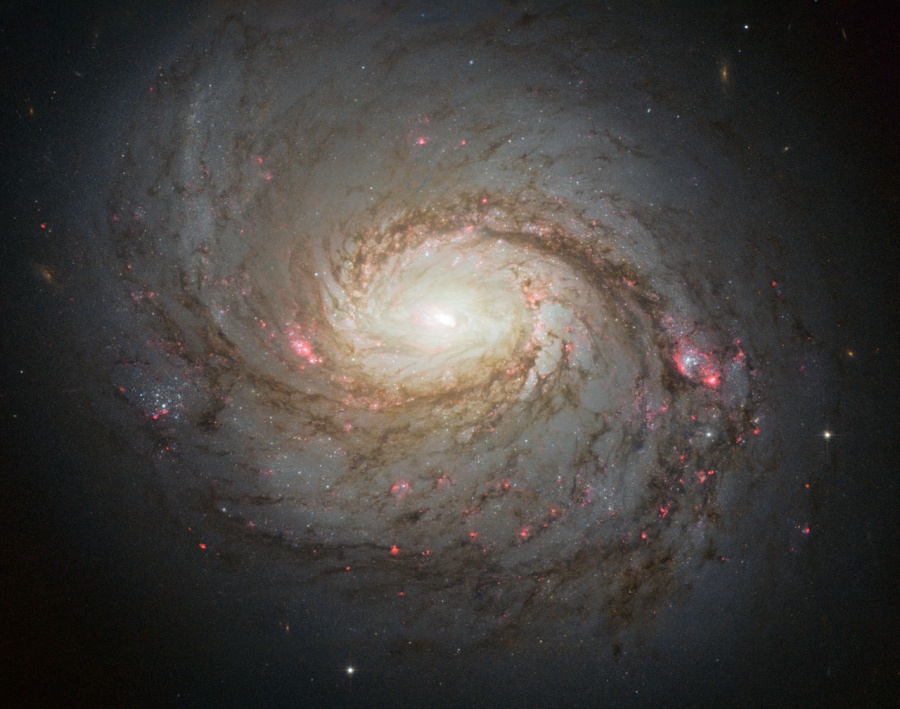
Image Credit: NASA, ESA, André van der Hoeven
Explanation: Face-on spiral galaxy M77 lies a mere 47 million light-years away toward the aquatic constellation Cetus. At that estimated distance, the gorgeous island universe is about 100 thousand light-years across. Also known as NGC 1068, its compact and very bright core is well studied by astronomers exploring the mysteries of supermassive black holes in active Seyfert galaxies. M77 is also seen at x-ray, ultraviolet, infrared, and radio wavelengths. But this sharp visible light image based on Hubble data follows its winding spiral arms traced by obscuring dust clouds and red-tinted star forming regions close in to the galaxy's luminous core.
Links in blue will help you in exploring more about the fact.
Monday, December 01, 2008
Smiley Sky of 1st December, 2008 New Delhi


You will see a "conjunction", as seen above in the picture taken by me from New Delhi India, of the crescent moon with two bright planets - Venus and Jupiter - this evening. Today, in the early evening, go out as soon as it starts getting dark and look south west, where the sun sets. Look for the thin crescent Moon. "The very bright 'evening star' just to the left of the moon is the planet Venus. “The other bright star above to the right of the moon is Jupiter." This will be visible for about two hours after the sun has set, for one evening only. "If you watch closely enough, you will notice the moon moving eastwards in its orbit around the Earth - the gap between Jupiter and the Moon will increase slightly. No equipment is necessary and it can be seen even from brightly-lit cities such as New Delhi.
Is'nt it Smiley? May God Bless All!
Thursday, August 21, 2008
Saturday, August 16, 2008
Ozone Gas depletion process
Here is an animation for better understanding of the Ozone gas depletion process.
Part - 1
Part - 2

Explanation:
1. The atmosphere acts as a natural filter, absorbing harmful shorter wavelengths such as X-rays, UV rays, Gamma rays yet allows life giving visible light and infrared wavelength to pass.
One such gas Ozone in ozonosphere protects us from UV rays.
2. Ozone is a molecule formed by three atoms of oxygen, weakly bounded together in an unstable arrangement.
3. As oxygen levels in Earth’s atmosphere increased over billions of years, some oxygen gas (O2) migrated into the stratosphere where the UV radiation reacted and formed ozone layer. In this way ozone layer formed.
4. After World War II, humans developed chemicals for electronics industries. These are chloroflurocarbons (CFCs) compounds. It comprises of chlorine (CI), fluorine (F) and carbon (C).
These CFC molecules are inert in lower atmosphere but causes havoc in stratosphere. The UV rays cracks the CFC molecule apart, freeing the chlorine (CI) atom.
5. In these photochemical reactions the freed CI atom starts destroying ozone molecules. It turns ozone into oxygen gas molecules.
6. The problem is that oxygen gas is transparent to UV rays. Thus, we have our present atmospheric condition where the increased UV rays are threatening the living systems on the Earth.
Part - 1

Part - 2

Explanation:
1. The atmosphere acts as a natural filter, absorbing harmful shorter wavelengths such as X-rays, UV rays, Gamma rays yet allows life giving visible light and infrared wavelength to pass.
One such gas Ozone in ozonosphere protects us from UV rays.
2. Ozone is a molecule formed by three atoms of oxygen, weakly bounded together in an unstable arrangement.
3. As oxygen levels in Earth’s atmosphere increased over billions of years, some oxygen gas (O2) migrated into the stratosphere where the UV radiation reacted and formed ozone layer. In this way ozone layer formed.
4. After World War II, humans developed chemicals for electronics industries. These are chloroflurocarbons (CFCs) compounds. It comprises of chlorine (CI), fluorine (F) and carbon (C).
These CFC molecules are inert in lower atmosphere but causes havoc in stratosphere. The UV rays cracks the CFC molecule apart, freeing the chlorine (CI) atom.
5. In these photochemical reactions the freed CI atom starts destroying ozone molecules. It turns ozone into oxygen gas molecules.
6. The problem is that oxygen gas is transparent to UV rays. Thus, we have our present atmospheric condition where the increased UV rays are threatening the living systems on the Earth.
Saturday, May 24, 2008
Well done!

The students of class 12 section C has shown that ICT in education is fruitful. They had utilised this blog and other offline tools to learn geography. Out of 27 students 6 got A1 grades and 15 of them scored Distinction and more marks in the Board Exam 2008. Surprisingly, students who took help from online and offline tools scored better marks than those who were averse to using ICT and related technologies in teaching.
Monday, May 19, 2008
Notice regarding Disaster Management, Unit 5 of Social Science, class X
Dear Students,
Disaster Management in Social Sciences of class X will now be evaluated through one Project work and one assignment.
Detailed new guidelines are as follows :-
1. Tests:
There will be no test from Disaster Management. Other things remain the same.
2. Assignments – Class and Home
You are expected to do 4 different assignments in Social Science. Out of these, one assignment will be from Disaster Management.The remaining three assignments will be from Geography, Economics & Pol.Sci and History. These assignments could be based on the suggested activities in the textbook.
3. Project Work:
Every student has to compulsorily undertake one project on Disaster Management only. You have to make a choice from the list of topics enclosed here. The textbook entitled “Together Towards a Safer India, Part III”, is recommended for carrying out the project work. You will be sharing your project with other students or teachers through exhibitions, panel discussions, etc
List of Disaster Management Topics for Project work, Class X
Disaster Management Book Class X Click here (3.5 Mb)
Wednesday, April 30, 2008
Social Science projects - IX
Why projects in Social science?
Education is a developmental process, which transforms us. It brings about a change in the mental and physical behaviour. To bring about this change, we need to introduce concepts, generalizations, issues and skills, which seem relevant to our lives.
Social Science is one of the subjects which brings all of closer to our environment, society
and the geographical, social , economic and political processes . It enables us to understand the process of social change and the role that we can play towards this change.
With the onset of new millennium, we are facing many challenges. Information explosion and widespread use of information technology has given us whole lot of information and data. Therefore its necessary for us to make sense out of it. In Social Science education particularly there has been a felt need to make its learning interesting, motivating and participatory in nature. Sensing this need we have to do projects in Social Science.
Students of class IX can download the Internal assessment Project list from here
(Note: You need Adobe Reader to view this pdf file)
Tuesday, February 26, 2008
Assignments for Board exams 2008
As the board Exams are on nearing up you may be trying hard and smart. Just to ease your learning here are some of assignmnets for Class XII Geography.
click on geography assignment to download.
All the Best to you all.
click on geography assignment to download.
All the Best to you all.
Thursday, January 24, 2008
Indian States!!! See how much you know

How much do you know about the location and map of Indian states?
Want to know more about States.........then click on the map of india and start locating correct states.
There are max. 105 points if you answer all correct.
All the best.
Subscribe to:
Posts (Atom)
Exploring the Depths: The Mysterious Interior of the Earth
Fun Earth Facts Deepest Hole Ever Dug : Humans have only scratched the surface! The deepest hole ever dug is the Kola Superdeep Borehole ...

-
CBSE board examination of class 12 Geography includes 5 marks of identification items on world map. Those students who wish to aspire for c...
-
 Dear students you can view CBSE Sample Paper for coming board exams of 2008 in the link provided below. CBSE Sample Paper 2008